Rob Beezer kicked off the morning with a discussion on print-on-demand, and how to get your book published—see Lulu (lulu.com), Lightning Source (https://www.lightningsource.com), Orthogonal Publishing (http://www.orthogonalpublishing.com), createspace (https://www.createspace.com). You may or may not need an ISBN number. You can buy them on the web. You might want more than one ISBN number (books in a series, a related solutions manual, etc). The rest of the morning was occupied with breakout sessions, one of which was about writing XSL files. Really cool! Today is the last day of the AIM workshop and I have a full day of travel ahead of me tomorrow.
Friday, April 29, 2016

Thursday, April 28, 2016
Day 4 at the AIM MBX Workshop—More on graphics and a library tour
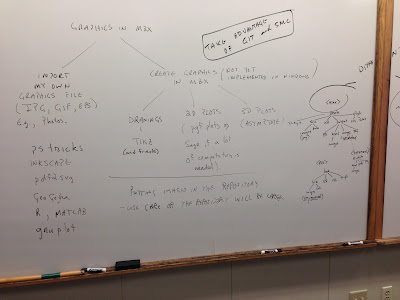
I have thought a little more about how graphics in MBX in the last 24 hours. There is a difference between graphics on the printed page (e.g., a PDF copy of your book) and the web (an HTML version). Printed graphics are static but graphics on a web page need to be able to scale. And there are raster images as well as vector graphics images. You might have photos, images from a previous project, images produced by a third party program such as GeoGebra, or you might be generating your images in your MBX project. Here is a flow chart illustrating the process for getting graphics into MBX.
After helping a few other people over the last few days, I have realized how important it is to keep things organized. If you are not organized, neither you or MathBook XML will be able to find the files that they need to generate your book. While there is no one way to set up the directories on your computer, the following picture may give you some ideas.

See the chapter on processing, tools and workflow in Rob Beezer's MathBook XML Author's Guide (http://mathbook.pugetsound.edu/doc/author-guide/html/processing.html).
To keep abreast of the most recent issues in MBX, subscribe to the Google Group, "mathbook-xml-support."
Now for the really cool part of the day—a trip to the AIM Library. When David Farmer announced that we were going to tour the AIM library after lunch, I assumed that we were going to be led over the book shelves in AIM. Instead, we went downstairs to a beautiful library were the "real books" were housed. We were able to view rare mathematics books, some of which were printed in the 15th century. Notice the author on the title page of the book in the first photo below. Really cool!!!


See the chapter on processing, tools and workflow in Rob Beezer's MathBook XML Author's Guide (http://mathbook.pugetsound.edu/doc/author-guide/html/processing.html).
To keep abreast of the most recent issues in MBX, subscribe to the Google Group, "mathbook-xml-support."
Now for the really cool part of the day—a trip to the AIM Library. When David Farmer announced that we were going to tour the AIM library after lunch, I assumed that we were going to be led over the book shelves in AIM. Instead, we went downstairs to a beautiful library were the "real books" were housed. We were able to view rare mathematics books, some of which were printed in the 15th century. Notice the author on the title page of the book in the first photo below. Really cool!!!


Wednesday, April 27, 2016
Day 3 at the AIM MBX Workshop—More on Git, Graphics and WebWork into MBX
It's Day 3 at the Open textbooks in MathBook XML Workshop at American Institute of Mathematics. The morning was filled with presentations on getting graphics into MathBook XML and how to use WeBWork with MathBook XML.
First let's do a follow up on Git. You can install a command line version of Git and xsltproc on Windows. If you search on google, you will find what you need to know, but the following pictures may help.


A note on using the GitHub app instead of opening a terminal window and using the command line version of Git. According to Rob Beezer, "Using a front-end app is like using recreational drugs. At first it will be really cool and a lot of fun, but it will eventually ruin your life." He was thinking of me when he said this. After being burned badly and scolded by Rob, I NEVER use the GitHub app.
Alex Jordan give a great presentation on how to integrate WeBWork into MBX. I missed the first part of the presentation, so checkout out Rob Beezer's blog (http://www.beezers.org/blog/bb/) for more information.
Finally, I gave a talk on how TikZ and how to get Sage plots and graphics into MathBook XML (http://faculty.sfasu.edu/judsontw/talks/AIM-April-2016.pdf).
As usual, we spend the afternoon in break out sessions.
First let's do a follow up on Git. You can install a command line version of Git and xsltproc on Windows. If you search on google, you will find what you need to know, but the following pictures may help.


Alex Jordan give a great presentation on how to integrate WeBWork into MBX. I missed the first part of the presentation, so checkout out Rob Beezer's blog (http://www.beezers.org/blog/bb/) for more information.
Finally, I gave a talk on how TikZ and how to get Sage plots and graphics into MathBook XML (http://faculty.sfasu.edu/judsontw/talks/AIM-April-2016.pdf).
As usual, we spend the afternoon in break out sessions.
Tuesday, April 26, 2016
Day 2—Git at Open textbooks in MathBook XML Workshop
If you are going to collaborate with co-authors over time and space, you need a method of communication. If you are going to communicate across distance, your options snail mail, the telephone, or some form of electronic communication. Electronic communication might be email, DropBox, or the Cloud. If you use one of the above and working with others, you will have to be very careful that you don't get in one another's way. Two people editing the same file at the same time could result in chaos.
The answer to this dilemma is to use a version control system such as one of the ones used by software engineers. Git is such a system. With Git, you can create a project repository that lives on the Internet. Each co-author can pull from that repository, work locally on his or her local computer, and then push your changes back to the repository, where any conflicts can be resolved. You may have several versions on your local machine and then push up to the repository once you are satisfied with any additions or changes that you have made. Every Git working directory is a full-fledged repository with complete history and full version-tracking capabilities, independent of network access or a central server. Like the Linux kernel, Git is free software distributed under the terms of the GNU General Public License version 2.

Of course, you will need someplace to host your project repository. GitHub (https://github.com) is one possibility. You can host a public project on GitHub for free, but there is a monthly subscription fee if you want to host private projects. I currently have five private projects that are books, instructor solutions manuals, and class notes in various stages of development. I am finding GitHub very useful. Some of my other colleagues are either hosting or obtaining projects from GitHub.
To learn more about Git and GitHub, see http://mathbook.pugetsound.edu/gfa/html/git-for-authors.html.
The answer to this dilemma is to use a version control system such as one of the ones used by software engineers. Git is such a system. With Git, you can create a project repository that lives on the Internet. Each co-author can pull from that repository, work locally on his or her local computer, and then push your changes back to the repository, where any conflicts can be resolved. You may have several versions on your local machine and then push up to the repository once you are satisfied with any additions or changes that you have made. Every Git working directory is a full-fledged repository with complete history and full version-tracking capabilities, independent of network access or a central server. Like the Linux kernel, Git is free software distributed under the terms of the GNU General Public License version 2.

Of course, you will need someplace to host your project repository. GitHub (https://github.com) is one possibility. You can host a public project on GitHub for free, but there is a monthly subscription fee if you want to host private projects. I currently have five private projects that are books, instructor solutions manuals, and class notes in various stages of development. I am finding GitHub very useful. Some of my other colleagues are either hosting or obtaining projects from GitHub.
To learn more about Git and GitHub, see http://mathbook.pugetsound.edu/gfa/html/git-for-authors.html.
Monday, April 25, 2016
Day 1—Open textbooks in MathBook XML Workshop at American Institute of Mathematics
Greetings from the Open textbooks in MathBook XML Workshop (http://aimath.org/workshops/upcoming/mathbookxml/). I am here for a one-week workshop (April 25—29, 2016
) at the American Institute of Mathematics, San Jose, California. The workshop, organized by Rob Beezer, David Farmer, and Kent Morrison and sponsored by AIM and the NSF,is bringing together teams of authors of open source mathematics textbooks, developers of technical tools supporting authoring of these books, and experienced editors providing reviews, advice, and guidance. During the workshop, authors will begin by converting existing book projects from LaTeX to a highly structured format. This new format will then easily convert to print, PDF, HTML, EPUB, and Jupyter Notebooks.
After a brief welcome from Brian Conrey, the director of AIM, and the organizers, we went through the room for introductions (about 30 people). It takes a while for each person to tell their life story and describe the project that brought them to the workshop. There are lots of people who are interested in writing open source textbooks, making books available in different formats, and incorporating tools such as WebWork. People are bringing a wide variety of skill sets to the workshop. Participants are here for a variety of reasons:
We spent the afternoon learning about SageMathCloud (https://cloud.sagemath.com) and writing a simple MathBook XML article. The SageMathCloud allowed everyone to work in their own Linux computer.
Here are some useful references on MathBook XML:
After a brief welcome from Brian Conrey, the director of AIM, and the organizers, we went through the room for introductions (about 30 people). It takes a while for each person to tell their life story and describe the project that brought them to the workshop. There are lots of people who are interested in writing open source textbooks, making books available in different formats, and incorporating tools such as WebWork. People are bringing a wide variety of skill sets to the workshop. Participants are here for a variety of reasons:
- I want to write my own book because I haven't found one that fits the needs of my students.
- I am interested in inquiry-based learning.
- I want to make my book available in a variety of formats. I tell my student not to read their online textbooks on their smart phone, but they continue to ignore me. So I guess that I had better make the textbook available in a format more friendly to the smart phone so at least they will not go blind trying to read the small print of a PDF version.
- I want technology to be an integral format of my book.
- I want to be able to collaborate with a group of authors.
We spent the afternoon learning about SageMathCloud (https://cloud.sagemath.com) and writing a simple MathBook XML article. The SageMathCloud allowed everyone to work in their own Linux computer.
Here are some useful references on MathBook XML:
- HTML: http://mathbook.pugetsound.edu/doc/author-guide/html
- PDF: http://mathbook.pugetsound.edu/doc/author-guide/mathbook-author-guide.pdf
You need to to install MathBook XML first using git. Git for authors:
- HTML: https://mathbook.pugetsound.edu/gfa
- GitHub: https://github.com/BooksHTML/gfa.git
Friday, February 12, 2016
Day 2—Critical Issues in Mathematics Education (MSRI 2016)

The morning schedule:
- 8:30 AM–8:40 AM. Shifting focus from learning to observe to using observing to learn—Mark Hoover (University of Michigan)
- 8:40 AM –9:45 AM. Structuring the practice and use of observation to improve developmental mathematics courses in a mathematics department—Dawn Berk (University of Delaware), James Hiebert (University of Delaware). One of the key points was the evaluation of lessons and not teachers. They are doing coordinated lesson plans for the number and operations courses for K–6 preservice teachers as well as the foundational math courses leading up to calculus. They are emphasizing longterm planning and development (20+ years). The scripted lesson question arose. It sounds like this lesson plans are more scripted than most. The Q&A session is worth watching. Watch the MSRI video stream. They give an evolving protocol for facilitating video clubs during the last 10 minutes.
- 9:45 AM–10:45 AM. Preparing secondary mathematics teachers to facilitate video clubs— Michael Driskill (Math for America), Kristen Smith (Math for America). They have a protocol for facilitating video clubs. They showed video of teachers watching video. The facilitator views and edits the teacher's video ahead of the video club session. The video club focused on student thinking, but the facilitator focused on teacher thinking.
- 11:15 AM - 12:15 PM Parallel Sessions 2.
- Parallel session 2.a: Advancing quality teaching: Using video to support professional development in the Community College Pathways network—Ann Edwards (Carnegie Foundation for the Advancement of Teaching)
- Parallel session 2.b: Teaching Triads: Enhancing teaching through the use of Cognitive Coaching—Scott Peterson (Oregon State University)
- Parallel session 2.c: Key ideas for effective professional development: Purposeful classroom observation and non judgmental data collection—Hyman Bass (University of Michigan), Akihiko Takahashi (DePaul University). I attended this session. It was in the Baker Boardroom, so it was not recorded, but slides are available. The major forms of PD in Japan are lesson study, observing demonstration lessons, and lectures/workshops (often during summer). A key idea is the difference between lesson study and demonstration lessons. Demonstration lessons (and their associated videos) capture the complete story of the lesson as opposed to "video club" clips which are usually 2–5 minutes. Lesson Note http://lessonnote.com) is an app for taking notes while observing lessons and is available for the iPad. This is a VERY slick app!
The afternoon schedule:
- 1:00 PM—2:00 PM. Parallel Sessions 3.
- Parallel session 3.a: Reflecting on one’s own classroom video to enhance classroom interactions—William Day (Math for America DC), Julia Penn (Math for America DC)
- Parallel session 3.b: Lessons learned from Lesson Study—Travis Lemon (MfA - Utah)
- Parallel session 3.c: Observing across communities: Learning to observe undergraduate mathematics classes by supervising student teachers—Cody Patterson (University of Arizona)
- Parallel session 3.d: Leading mathematics observations: An observational tool for providing feedback—Nicole Garcia (University of Michigan), Meghan Shaughnessy (University of Michigan)
- 2:00 PM–3:00 PM. Observing and talking about teaching: Departmental leadership—Deborah Hughes Hallett (University of Arizona), Wayne Raskind (Wayne State University), Ayse Sahin (Wright State University), Douglas Ulmer (Georgia Institute of Technology). A discussion of the views and concerns of department chairs, deans, etc.
- 3:30 PM–4:30 PM. A conversation about practical next steps—Deborah Ball (University of Michigan). There were five breakout groups to discuss questions such as different ways to observe teaching, the use of different lenses in observation, access to shared materials and video beyond the CIME workshop, what did we learn at the CIME workshop, and what structures could support observation and the improvement of teaching. Watch the video.
- 4:30 PM–5:00 PM. Closing session: Reflections on ideas discussed at the workshop—James Hiebert (University of Delaware), Anna Sfard (The University of Haifa)
The CIME workshop has been very productive, but I am exhausted after two and a half days. Heading home early tomorrow.
Thursday, February 11, 2016
Day 1—Critical Issues in Mathematics Education (MSRI 2016)
The 2016 CIME workshop actually began Wednesday afternoon (Day 0?) with a couple of talks that framed the workshop. Day 1 began this morning at 8:30 AM with a wonderful presentation by Deborah Ball,(How) Can we “see” the work of teaching mathematics?. All of the talks will eventually be streamed online from the MSRI's website at http://www.msri.org/workshops/793/schedules.
Today's morning schedule:
Today's morning schedule:
- 8:30 AM–9:45 AM. (How) Can we “see” the work of teaching mathematics?—Deborah Ball (University of Michigan). Watch the video because this was one of the best presentations of the day.
- 9:45 AM–10:45 AM.vSeeing the math in teaching—Roger Howe (Yale University), Lindsey Mann (University of Michigan). Video available.
- 11:15 AM–12:15 PM.vAttending to student thinking and their interactions when working in small groups—Chris Rasmussen (San Diego State University). Video available.
The afternoon schedule:
- 1:00 PM–2:30 PM Observing practices that support learners’ identity development and participation in mathematics classrooms—Lawrence Clark (University of Maryland), Imani Goffney (University of Houston), Whitney Johnson (Morgan State University), Danny Martin (University of Illinois, Chicago). Video available.
- 2:45 PM–3:45 PM Parallel sessions (I was only able to attend 1.a and 1.b.)
- 1.a: Mathematical micro-identities: Students’ positioning and learning during mathematics lessons—Marcy Wood (University of Arizona). Video available.
- 1.b: Watching mathematicians at work: Mathematical knowledge for teaching calculus and the practice of examining student work—Natasha Speer (The University of Maine). Natasha's research project sounds interesting and directly applicable to how we teach the first two years of undergraduate mathematics. Video available.
- 1.c: Using video to develop pre-service teachers’ professional vision of ambitious mathematics instruction—Elizabeth van Es (University of California, Irvine)
- 1.d: Teaching and learning mathematical practices in the early elementary grades—Hyman Bass (University of Michigan), Sarah Selling (University of Michigan)
- 4:15 PM–5:15 PM Designing video clubs for teacher learning—Miriam Sherin (Northwestern University). WOW! What a great idea. Video clips would be easy to implement with graduate teaching assistants. Watch the MSRI video of this talk.
- 5:15 PM–6:00 PM The practice and use of observation in powerful professional development: The teaching-for-robust-understanding (TRU) framework—Alan Schoenfeld (University of California, Berkeley). Some great material here. Definitely watch the MSRI video. Schoenfeld's websites are particularly useful: http://map.mathshell.org/index.php and http://ats.berkeley.edu.
Overview—Critical Issues in Mathematics Education (MSRI 2016)
The Critical Issues in Mathematics Education Workshop (CIME) 2016 at the Mathematical Sciences Research Institute began yesterday evening. This year's topic is Observing, Evaluating and Improving Mathematics Teaching from the Early Grades through the University. The workshop's website is https://www.msri.org/workshops/793.
The 2016 CIME workshop is focusing directly on the teaching of mathematics at the university and precollege levels through close observation and discussion of video tapes. The goal of the workshop is to develop language and methods for describing, analyzing and evaluating what can be seen in the classroom, with the ultimate goal of helping us shape and improve teaching our own and more broadly.
The workshop is being guided by the following questions.
The 2016 CIME workshop is focusing directly on the teaching of mathematics at the university and precollege levels through close observation and discussion of video tapes. The goal of the workshop is to develop language and methods for describing, analyzing and evaluating what can be seen in the classroom, with the ultimate goal of helping us shape and improve teaching our own and more broadly.
The workshop is being guided by the following questions.
- What skills are needed for observing teaching in ways that inform improvement efforts? What is involved in observing teaching? What is the teacher saying and doing? What are students saying and doing? What is the mathematics at play? What else is happening? And what do these imply for teaching?
- How can the practice and use of observation be structured in order to improve mathematics teaching? What approaches are available? What are their strengths and weaknesses?
- Observation-based assessment of teaching: Why, what, and how? What are the risks?
- How can we develop and sustain a cross-professional community that observes and evaluates teaching in such a way that different communities communicate with and learn from each other to support a cycle of improvement in the teaching of mathematics at all levels? The workshop will provide a library of videos of mathematics teaching for study. In addition, participants are encouraged to submit a short video clip of their own teaching, together with a brief background commentary. These videos will provide a central text for our collective work on discussing and assessing mathematics teaching.
Friday, June 21, 2013
Sage Education Days 5 - Day Three
Here is today's schedule. Some great talks. We also made some good plans for the coming year.
Friday
|
June 21
| ||
9:30 AM
|
Announcements
| ||
20min
|
Cryptography
|
Chris Davis
| |
20min
|
Math. Finance
|
Gregory Bard
| |
15min
|
Abstract Algebra
|
Barry Balof
| |
30min
|
Webwork
| ||
30min
|
SALG Surveys
|
Susan Lynds
| |
afternoon
|
Working groups
| ||
2:30 PM
|
UTMOST PI Meeting
| ||
4:40 PM
|
Status Reports
| ||
5:00 PM
|
Thirty-minute survey
|
Sage Education Days 5 - Day Two

Today's schedule. Rob has finally convinced me that XML is the future, especially if you plan to publish in multiple formats.
Thursday
|
June 20
| ||
9:30 AM
|
Announcements
| ||
20min
|
Publishing with XML
|
Rob Beezer
| |
20min
|
Sage Widgets for Teaching Calculus
|
Jeff Denny
| |
20min
|
Sage in Calculus
|
Brian Beavers
| |
20min
|
Sage in class: MV calc. & hyp. arrangements
|
David Perkinson
| |
20min
|
Sage for undergrads via interacts and worksheets, Running own cell and notebook servers
|
Andrey Novoseltsev
| |
afternoon
|
Working groups
| ||
3:00 PM
|
Discussion: Sage Book Series
| ||
4:40 PM
|
Status Reports
| ||
5:00 PM
|
Ten-minute survey
|
Wednesday, June 19, 2013
Sage Education Days 5 - Day One
Greetings from Sage Education Days 5. About 30-35 of us are gathered at the University of Washington until Friday to work on using Sage in the classroom. Today's schedule is below.
The Sage Cell Server looks very promising. Basically, it allows a single Sage cell to be embedded as a link into a webpage, a pdf document, etc. Go to https://sagecell.sagemath.org to get started.
William Stein demonstrated the Sage Cloud (https://cloud.sagemath.com). This is going to replace the notebook.
During the afternoon, we had time to circulate or work on projects. I worked on updating the solutions manual for AATA and getting everything into XML. I also spoke with several people about the next steps for UTMOST.
Wednesday
|
June 19
| ||
9:30 AM
|
Introductions
| ||
20min
|
Sage Cell Server
|
Jason Grout
| |
20min
|
Using Sage cell to create an online text
|
Karl-Dieter Crisman
| |
20min
|
Sage Cloud
|
William Stein
| |
afternoon
|
Working groups
| ||
4:40 PM
|
Status Reports
| ||
5:00 PM
|
Ten-minute survey
|
William Stein demonstrated the Sage Cloud (https://cloud.sagemath.com). This is going to replace the notebook.
During the afternoon, we had time to circulate or work on projects. I worked on updating the solutions manual for AATA and getting everything into XML. I also spoke with several people about the next steps for UTMOST.
Friday, April 5, 2013
Day 2 - Critical Issues in Mathematics Education (MSRI 2013)
Interesting license plate in the MSRI parking lot.
 The first talk of the day was about assessment, diversity, and equity. We heard from the Algebra Project (http://www.algebra.org) and recommendations for formative mathematics assessment for English learners (Judit Moschkovich, UC Santa Cruz). This talk focused on formative assessment and what is essential for good assessment of English learners. The are some very interesting and useful video clips at the Understanding Language website (http://ell.stanford.edu) as well as research papers. This is a great resource with separate resources dedicated to science, math, and English language arts. The techniques discussed are very useful for assessing all students. Hints for writing good word problems: changing passive voice to active, reduces nested and subordinate clauses, make the sentences shorter. Language is more than just vocabulary---it's structure. Maria Martiniello was supposed to attend the workshop, but encountered travel difficulties since she was coming from Venezuela. By the way, Bob Moses, the founder of the Algebra Project, is attending this workshop.
After the first talk, it was picture time and then back into our groups. The groups are now medium sized, each composed of three or four of our previous smaller groups. The task before us was to discuss the assessment items that we created in our small groups or the difficulties we had in writing our assessment items. There were almost 20 people in our medium sized group. We decided to focus more on the process of creating an individual assessment item rather than a specific item. One point that was stressed was the importance (and sometimes difficulties) of linking assessment items to specific content and practice standards.
The next presentation was SBAC: Challenges taken on a progress to date (Shelbi Cole) (see http://www.smarterbalanced.org). Only large projects such as Smarter Balanced Assessment Consortium can construct and maintain large item pools. SBAC is a consortium of 21 states. Released items and the summative assessment blueprint can be found on the SBAC website. Just a reminder that the other assessment consortium is Partnership for Assessment of Readiness for College and Careers or PARCC (http://www.parcconline.org).
After lunch, we organized into larger groups for debriefing what we did in our smaller groups. Other than sharing the assessment items that we created in our smaller groups, we discussed how well things worked by bringing together small, diverse groups to write assessment items. Personally, I think that it worked well.
The after lunch talk was given by Diane Briars, Broadening the conversation: issues and concerns. Diane will be the new NCTM President-Elect in October. For high-stakes testing at its worst, see the article in the Pittsburg Post Gazette, http://www.post-gazette.com/stories/opinion/perspectives/why-i-wont-let-my-son-take-the-pssa-681537/. Research shows that the more time that you spend doing test prep, the worse the test scores are. Good instruction means good scores on well-crafted and meaningful exams. The Math Reasoning Inventory has good formative assessment tools (https://mathreasoninginventory.com). Much of what Briars said, especially about concerns and challenges, was not new, but she said it well and was pretty much on target.
The workshop concluded with a panel discussion and then closing remarks by Alan Schoenfeld. The message from the panel seemed to be that we should focus on instruction. This confirms my long held belief that if you want to improve education you will get the most bang for your buck by training your teachers better and rewarding them more.
Flying back to Texas in the morning. At least I got bumped up to first class on both legs.

After the first talk, it was picture time and then back into our groups. The groups are now medium sized, each composed of three or four of our previous smaller groups. The task before us was to discuss the assessment items that we created in our small groups or the difficulties we had in writing our assessment items. There were almost 20 people in our medium sized group. We decided to focus more on the process of creating an individual assessment item rather than a specific item. One point that was stressed was the importance (and sometimes difficulties) of linking assessment items to specific content and practice standards.
The next presentation was SBAC: Challenges taken on a progress to date (Shelbi Cole) (see http://www.smarterbalanced.org). Only large projects such as Smarter Balanced Assessment Consortium can construct and maintain large item pools. SBAC is a consortium of 21 states. Released items and the summative assessment blueprint can be found on the SBAC website. Just a reminder that the other assessment consortium is Partnership for Assessment of Readiness for College and Careers or PARCC (http://www.parcconline.org).
After lunch, we organized into larger groups for debriefing what we did in our smaller groups. Other than sharing the assessment items that we created in our smaller groups, we discussed how well things worked by bringing together small, diverse groups to write assessment items. Personally, I think that it worked well.
The after lunch talk was given by Diane Briars, Broadening the conversation: issues and concerns. Diane will be the new NCTM President-Elect in October. For high-stakes testing at its worst, see the article in the Pittsburg Post Gazette, http://www.post-gazette.com/stories/opinion/perspectives/why-i-wont-let-my-son-take-the-pssa-681537/. Research shows that the more time that you spend doing test prep, the worse the test scores are. Good instruction means good scores on well-crafted and meaningful exams. The Math Reasoning Inventory has good formative assessment tools (https://mathreasoninginventory.com). Much of what Briars said, especially about concerns and challenges, was not new, but she said it well and was pretty much on target.
The workshop concluded with a panel discussion and then closing remarks by Alan Schoenfeld. The message from the panel seemed to be that we should focus on instruction. This confirms my long held belief that if you want to improve education you will get the most bang for your buck by training your teachers better and rewarding them more.
Flying back to Texas in the morning. At least I got bumped up to first class on both legs.
Thursday, April 4, 2013
Day 1 - Critical Issues in Mathematics Education (MSRI 2013)
Normally, all of San Francisco and the Golden Gate is visible from MSRI, but not today. It's foggy and rainy in the Bay Area today. Fortunately, someone offered me a ride up the hill to MSRI, and I didn't have to do the 25 minute walk to catch the shuttle.
 The basic format of the day is to alternate meeting in the MSRI Simons Auditorium for a one-hour talk with working in our breakout groups to design assessment items. The talks included Dissolving the boundaries (Bill McCallum and Jason Zimba), Assessment in practice: Use, needs, and examples (Eyal Wallenberg, Melanie Smith, David Baiz, & Jonathan Osler), Assessing complex human practices (Eva Baker), Assessment ABCs: Purpose, design, and examples (Mike Briscoe, Guillermo Solano-Flores, & Ann Shannon), and PARCC: Challenges taken on and progress to date (Doug Sovde). McCallum and Zimba set the general tone of the day. Wallenberg, Smith, Baiz, and Osler gave an a view of assessment from the trenches. What problems arise in the classroom? Do students lose interest or give up too soon? Baker spoke on what we know and what we don't know about assessment design. Check out http://www.cse.ucla.edu/products/resource/cresst_resource13.pdf or google for some of the other work that Baker has done on the content ontology for the CCSS at http://www.cse.ucla.edu. One comment at the end of Barker's talk is that we do not align assessment with instruction in the U.S., although there are exceptions.
The first talk after lunch was Assessment ABCs: Purpose, design, and examples (Mike Briscoe, Guillermo Solano-Flores, & Ann Shannon). See http://www.achievethecore.org. It is worthwhile noting that certain items are nonnegotiable if materials are to be aligned with the CCSS. Ann Shannon spoke on formative assessment. Note: The Shell Centre (http://www.mathshell.org) keeps coming up. Check out the Math Assessment Project on the website. They have an excellent collection of medium cycle assessment materials. Most of the Shell Centre materials such as the The Language of Functions and Graphs (1985) is available for free download. Originally, I had to pay for my copy.
The last talk of the day was PARCC: Challenges taken on and progress to date (Doug Sovde). See http://www.parcconline.org/parcc-assessment. There was a lot to digest here.
 The basic format of the day is to alternate meeting in the MSRI Simons Auditorium for a one-hour talk with working in our breakout groups to design assessment items. The talks included Dissolving the boundaries (Bill McCallum and Jason Zimba), Assessment in practice: Use, needs, and examples (Eyal Wallenberg, Melanie Smith, David Baiz, & Jonathan Osler), Assessing complex human practices (Eva Baker), Assessment ABCs: Purpose, design, and examples (Mike Briscoe, Guillermo Solano-Flores, & Ann Shannon), and PARCC: Challenges taken on and progress to date (Doug Sovde). McCallum and Zimba set the general tone of the day. Wallenberg, Smith, Baiz, and Osler gave an a view of assessment from the trenches. What problems arise in the classroom? Do students lose interest or give up too soon? Baker spoke on what we know and what we don't know about assessment design. Check out http://www.cse.ucla.edu/products/resource/cresst_resource13.pdf or google for some of the other work that Baker has done on the content ontology for the CCSS at http://www.cse.ucla.edu. One comment at the end of Barker's talk is that we do not align assessment with instruction in the U.S., although there are exceptions.
The last talk of the day was PARCC: Challenges taken on and progress to date (Doug Sovde). See http://www.parcconline.org/parcc-assessment. There was a lot to digest here.
Our working group broke into two subgroups: an algebra subgroup and a geometry subgroup. I chose the geometry group, not only because I am interested in geometry but also because it was the smaller of the two groups and needed more bodies. In the end, the geometry group had four people while the algebra group was possible twice as large.
During the first meeting of the geomety group, we began by examining a grade 9-10 geometry project on tesselations, that one of of out teacher used. We quickly agreed that tesselations offered an opportunity to explore what a student knows about polygons, regular polygons, interior angles of polygons as well as mathematical reasoning and proof. For example, what regular polygons will tesselate the plane and what regular polygons will not. During the afternoon session, we come up with a more focused assessment item involving regular hexagons, pentagons, and isosceles trapezoids. I will try to put up a link later.
On a side note, check out the videos on compass and straightedge constructions at http://www.mathopenref.com/tocs/constructionstoc.html.
The reception begins at 5:30. The food looks delicious.
The reception begins at 5:30. The food looks delicious.
Day 0 - Critical Issues in Mathematics Education (MSRI 2013)
The Critical Issues in Mathematics Education Workshop 2013 at the Mathematical Sciences Research Institute began yesterday evening. This year's topic is Assessment of Mathematical Proficiencies in the Age of the Common Core. The Common Core State Standards (CCSS) for mathematics can be found at http://www.corestandards.org/Math, and the workshop's website is http://www.msri.org/web/msri/scientific/workshops/show/-/event/Wm9625. There are lots of interesting people here: Deborah Ball, Hy Bass, Bill McCallum, Keith Devlin, and Bob Moses to name a few, but the majority of the attendees are university faculty and K-12 teachers.
After introductions and an overview of what we will be trying to accomplish during the workshop, Deborah Ball interviewed Andrea, a bright 11 year-old, for almost an hour. Among other topics, Deborah asked questions to find out Andrea's understanding of fractions. My hope that is that there will be a video available at some point. Similar videos are available elsewhere.
We broke into our individual working groups during the last part of the evening. Each group is charged with writing assessment items or protocols for the CCSS. My group will work on formative assessment for grades 6-8 and high school. I am not sure that we came to any great conclusions during out 30 minute breakout session last night other than getting to know each other.
Saturday, June 18, 2011
Sage Edu Days - Day Three
View from Dinner Last Night at the Seattle Tennis Club

This is the last day of Sage Education Days 3, and Seattle weather is back to normal---overcast with light rain. Here is a link to a video of yesterday's status reports http://www.youtube.com/watch?v=tqGFadFfYt8.
Linear Algebra
Rob Beezer (University of Puget Sound) told everyone about what he did on his sabbatical last year, including his stay at African Institute for Mathematical Sciences (AIMS) in Cape Town. Lots of Sage at AIMS. Great photos of the safari! Rob talked about his open-source book, A First Course in Linear Algebra. Up to date development information can be found at http://wiki.sagemath.org/devel/LatexToWorksheet. You can find the Sage worksheet version of AATA (my book) in the same place.
On a side note, I have a 400 page manuscript for an ordinary differential equations text. The text emphasizes systems and would make a good open-source textbook/Sage project. If someone is interested in working with me on this, please let me know.
Numerical Analysis
Jason Grout (Drake University) talked about teaching numerical analysis with Sage. Jason has lots of good ideas about how to use Sage in any course. He suggested setting up a specific account for students to turn in Sage assignments. Students can then share their assignments with the account. To grade an assignment, you can just log onto the account, execute all of the Sage cells, and make any needed comments in a different colored font.
Interact Design
Open mic session with MC Jason Grout (Drake University). Lots of interesting examples. See http://wiki.sagemath.org/interact/ for examples and http://sagemath.org/doc/reference/sagenb/notebook/interact.html#sagenb.notebook.interact.interact to start learning about how the interact works in Sage. Also go to http://www.sagenb.org/ and browse the published worksheets (no login required).
Writing interacts might make good student projects. John Perry said that he has a little experience using interacts this way. It would be easier to encourage some colleagues (who might not willing to write their own) to use interacts in the classroom if there is a place where we can direct them.
UTMOST Test Sites Meeting
This was an informal Q and A session. A copy of the original proposal can be found at http://artsci.drake.edu/grout/lib/exe/fetch.php/ccli-2009.pdf. Jason Grout is taking notes and will post to the UTMOST grant wiki.
Status Reports and Wrap-Up
Status reports will be on YouTube (accessible from the conference wiki). Personally, I have gotten tex2sws (textbook conversion) to work, have some new ideas on how to make Sage work in the classroom, met with the UTMOST group, and have gotten python to work on my iPhone. I am realizing that I knew a lot of UNIX and LINUX at one point and am going to have to relearn it.
Friday, June 17, 2011
Sage Edu Days - Day Two
Day Two
My talk was the first one of the morning. I spoke on teaching abstract algebra this spring with Sage. Sage worksheets and slides are on the wiki http://wiki.sagemath.org/education3.
Karl-Dieter Crisman (Gordon College) spoke on teaching number theory with Sage. Karl-Dieter uses a little more programming in his number theory course than I do in my abstract algebra course. Programming tends to scare my students, so I decided not to tell them that they were programming or using Python (on Rob Beezer's advice). Ideally, I would like them to come to my office and beg me to be able to use a "for loop." Karl-Dieter's published worksheets are available at http://sage.math.gordon.edu/.
Watching Vector Fields in 3-D
Linear Algebra Lab Manual
Ryan Grout (Brigham Young University and Jason Grout's younger brother) spoke about the decision to use Python (and Sage) instead of MatLab as part of a new, NSF funded curriculum at BYU on computational and applied mathematics. The choice to use Python (and Sage) over MatLab was made because of the need of a more general programming language than MatLab provides. The lab manuals are student written. The decision to make the lab manuals open source was made within the last month or so. Labs are not available online yet, but this could start to happen today.
SageTeX
Dan Drake (KAIST, Korea) gave the technical talk of the morning, getting and executing Sage commands in your LaTeX documents. Really neat examples! Dan showed how to offload some the the LaTeX work into Sage.
Important! Make sure that you use the correct style file. It has to match the version of Sage that you are using.
Status Reports
Technical reports and Sage Edu Days reports were combined this afternoon. Video reports will be available on the wiki http://wiki.sagemath.org/education3. Personally, I got sagetex and the textbook conversion process working, gave a talk, and attended the UTMOST PI meeting.
Michael Gage is working embedding JMOL into WeBWork and getting single cell Sage applets into WeBWork. Getting Sage into WeBWork is still a long ways away. Jason Aubrey is working on embedding WebWork problems into the Sage notebook. Progress is being made.
Thursday, June 16, 2011
Sage Edu Days - Day One Part 2
Here are some videos of the talks this morning.
- Sage Education Days 3: John Perry's talk on SageLets: http://www.youtube.com/watch?v=Y7MyzHubCNo
- Sage Education Days 3: John Travis -- Multivariable Calculus: Part I http://www.youtube.com/watch?v=rqACCzGYOm8 and Part II http://www.youtube.com/watch?v=SwgFWKK0oCg
Status Reports (Highlights)
- Rob has been helping people work with the conversion process. I'm making progress, but I'm not there yet.
- Version 4.7 is needed for certain commands subgroups of permutation groups.
- John and Jane are working on VirtualBox to get Sage to work better on Windows.
- The Sage worksheet version of AATA can be found at http://wiki.sagemath.org/devel/LatexToWorksheet?action=AttachFile&do=view&target=aata-sage-alpha1.zip
Morning of Day One at Sage Edu Days 3
Sage Edu Days
I am at Sage Education Days at the University of Washington in Seattle. The third Sage Education Days is being held in conjunction with Sage Days 31, at the University of Washington in Seattle, June 16-18, 2011. The wiki for Edu Days 3 can be found at
http://wiki.sagemath.org/education3. You can find the slides for all of the presentations as well as the Sage worksheets for the presentations.
What's Sage?
Sage is a free open-source mathematics software system. You might think of Sage as an open-source Mathematica but actually it is a bit more. Sage uses Python to combine many existing open-source mathematics software packages such as GAP, Maxima, and R. You can wither download Sage and run it on your notebook or desktop computer or you can try Sage by logging into a Sage server. You can even run Sage on an iPhone. Everything you need to know can be found at http://www.sagemath.org/
Project UTMOST
The goal of Project UTMOST is to demonstrate how Sage can be coupled with existing free open textbooks as a tool for faculty and institutions to more easily bring the power of mathematics software to students. Authors of open source software and open textbooks provide licenses that permit free copying and modifications of their work, allowing others to modify or extend them to suit their needs or make improvements. Primarily, UTMOST is converting existing open textbooks into web-based electronic texts that integrate traditional mathematical exposition with Sage code and hands-on demonstrations. Ten different undergraduate institutions are or will help test and refine these materials using a comprehensive, professional evaluation procedure. The main goal driving UTMOST is to create technical and pedagogical tools and methods that greatly simplify the deployment and use of powerful software to increase learning and experimentation in undergraduate mathematics.
Teaching Calculus with Sage
John Perry (University of Southern Mississippi) presented Interactive Calculus + "SAGElets". You can go to http://www.math.usm.edu/sage/ for lots of good example labs and worksheets for Calculus I.
Multivariable Calculus
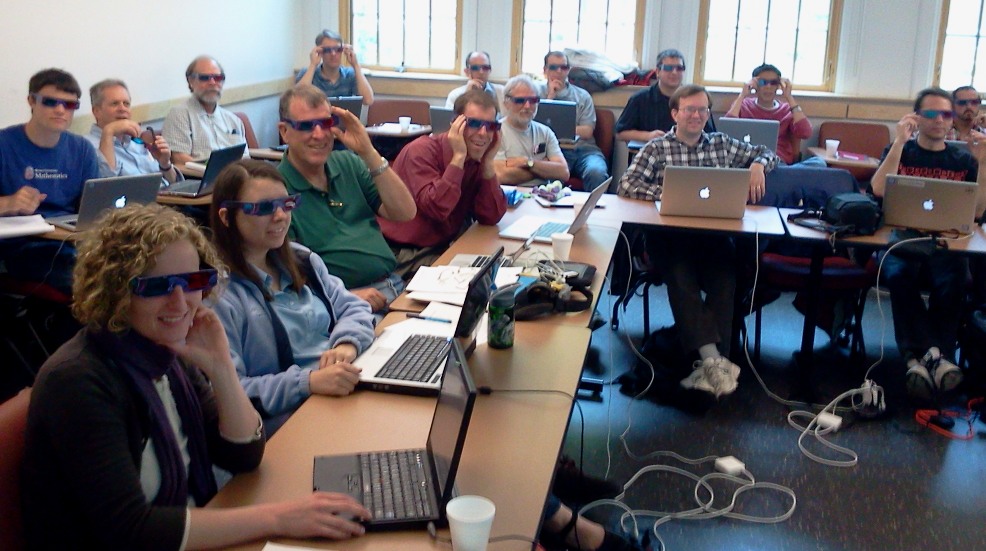
John Travis (Mississippi College) presented Sage in multivariate calculus. John is relatively new to Sage. He took the Sage PREP workshop last summer. John's presentation and worksheets are on the wiki. Much of the presentation was devoted to how one could use Sage in the classroom to help students with visualization. Cool 3-D graphics! This works extremely well with three-dimensional vector fields. you just need 3-D glasses.
It's harder to come up with worthwhile student projects. Here are some ideas for student projects that I have used in the past (Thanks to Wilfried Schmid at Harvard).
- Give students the code to plot a cycloid and then ask them to write the code to plot an epicycloid.
- Ask students to plot a monkey saddle and then a generalized monkey saddle.
Textbook Conversion
Rob Beezer (University of Puget Sound) presented Textbook conversions. The goal is to convert book length projects into Sage worksheets. The main tool for converting LaTeX to various forms is tex4ht. A bit of a technical talk, but nicely done and I learned some new things. Will these tools change the way that author textbooks or the way that students read their texts? Also needed is an author's guide.
General Comments and Ideas
- Have a Sage worksheet for each class that you are teaching.
- Project UTMOST needs a website.
- Could we use what Rob has done to convert the SFA calculus labs?
The afternoons are devoted to working individually or in small groups on projects followed by status reports at the end of the day (a separate blog entry).
Saturday, June 4, 2011
Legacy Conference - Day 3
What has Ally Learned? Outcomes for Students and Teachers of IBL Mathematics Courses
Sandra Laursen (Joint work with Marja-Liisa Hassi, Marina Kogan, and Anne-Barrie Hunter, Ethnography & Evaluation Research, and Tim Weston, ATLAS Assessment and Research Center, University of Colorado Boulder)
Abstract: We have recently completed data analysis for a large, multi-method study of inquiry-based learning in college mathematics as implemented across four university IBL Mathematics Centers. From classroom observations and interviews, we identify key features of these courses that were generally shared despite variations in style and implementation. We share some of the rich evidence from student surveys, tests, interviews, and academic records about how students benefited from IBL experiences and who appeared to benefit in particular. Finally, we highlight the learning processes that were important in these IBL classrooms, particularly the “twin pillars” of deep engagement in mathematics and collaboration with others.
Comments: The executive summary and the full report can be found at http://www.colorado.edu/eer/research/steminquiry.html.
General Remarks about this year's Legacy Conference
This year's conference is perhaps the best one that I have attended. Here a few things that have made an impact on me.
- I have had an interest in Emerging Scholars Programs for quite some time. Thanks to Eric Tsu's talk, I have a be3tter idea of how we might start one at SFA.
- Math circles for middle school teachers. It's time to start one.
- I think that I have arrived at better definition of inquiry-based learning of at least one that works for me.
- This year's conference seemed to be more focused on IBL in general as opposed to Moore Method.
Final Note
Waiting in the airport for my flight back to Texas. Next blog entry will be from Edu Days 3 in Seattle (in about two weeks).
Friday, June 3, 2011
Legacy Conference - Day 2
I spent the first hour of the morning with my co-author, Matt Leingang, trying to get a math ed paper ready for resubmission to the Journal of STEM Education, only to find out that the paper needs to be submitted in APA style. We had written the paper in LaTeX. What I had hoped to be a 15 minute job, will probably turn into a half day chore.
Judy Holdener, Kenyon College - To understand is to invent: empowering students with technology
Abstract: As teachers of mathematics, we strive to get our students to move beyond the surface knowledge of our discipline and to delve deeply into the creative process of mathematics. Our students are not vessels to be filled with facts, but rather active problem-solvers who learn by exploring, manipulating, experimenting, questioning, and searching out answers for themselves. Activity is essential. In this talk I will present concrete ways in which I have used technology as a vehicle for such activity. In doing so, I will reveal my own views relating to the creative process of mathematics – views that place a large weight on the importance of mental imagery, playful experimentation, and lateral thinking in mathematics.
Comments: Great talk. Lot's of good examples integrating Gap and IBL. I wonder if she has thought of using Sage.
Decided to take a pass on the five minute talks this year.
Eric Hsu, San Francisco State University - Making Practice Visible: The Emerging Scholars Program and IBL
Abstract: The Emerging Scholars Program is an intensive non-remedial mathematics program which focuses particular attention on increasing success of underrepresented minorities. This model was created 35 years ago, and has been adopted by over a hundred colleges around the U.S. At the heart of the model is a multicultural workshop where students solve problems in groups and individually. We discuss how the role of IBL evolved in a natural way in response to ethnographic research into differences in student academic culture as well as the practical needs of the program.
Comments and Questions: Great talk. The slides are supposed to be available online (eventually).
How one person's abilities compare in quantity with those of another is none of the teacher's business. It is irrelevant to his work. What is required is that every individual shall have opportunities to employ his own powers in activities that have meaning. Mind, individual method, originality (these are convertible terms) signify the quality of purposive or directed action. - John Dewey from Democracy and Education
In the context of Dewey's quote, it seems that the use of inquiry can facilitate giving each student the opportunity to “employ his own powers in activities that have meaning" toward the goal of learning. In this presentation we propose some answers to the following questions:
Comments: Really didn't have anything.
Abstract: Math Teachers’ Circles are a form of professional development that uses inquiry-based learning techniques to help practicing teachers improve their mathematical knowledge through content rich problem solving. Collaborations are made between university faculty, middle school teachers, and K-12 administrators to create a learning community. These sessions are held to give the middle school teachers a chance to learn mathematics and solve problems for their own enjoyment. Emerging research on Math Teachers’ Circles indicates that they are successful in increasing teachers’ mathematical knowledge for teaching, and that participating teachers report increases in their confidence, interest in mathematics, and use of problem solving in their classrooms. In this session, we will briefly discuss how we began our Math Teacher’s Circles. We will focus on the connection between inquiry-based learning and Math Teachers’ Circles. Specific examples will be provided, including an interactive problem solving session, to help attendees get a feel for the power of this inquiry-based professional development experience.
Comments:
Comments: Good overview of how the English university system works as far as students enrolled in a bachelor's degree in mathematics program. Teaching IBL courses can be a problem since many courses have a 200+ enrollment.
Judy Holdener, Kenyon College - To understand is to invent: empowering students with technology
Abstract: As teachers of mathematics, we strive to get our students to move beyond the surface knowledge of our discipline and to delve deeply into the creative process of mathematics. Our students are not vessels to be filled with facts, but rather active problem-solvers who learn by exploring, manipulating, experimenting, questioning, and searching out answers for themselves. Activity is essential. In this talk I will present concrete ways in which I have used technology as a vehicle for such activity. In doing so, I will reveal my own views relating to the creative process of mathematics – views that place a large weight on the importance of mental imagery, playful experimentation, and lateral thinking in mathematics.
Comments: Great talk. Lot's of good examples integrating Gap and IBL. I wonder if she has thought of using Sage.
Five Minute Talks
Decided to take a pass on the five minute talks this year.
Eric Hsu, San Francisco State University - Making Practice Visible: The Emerging Scholars Program and IBL
Abstract: The Emerging Scholars Program is an intensive non-remedial mathematics program which focuses particular attention on increasing success of underrepresented minorities. This model was created 35 years ago, and has been adopted by over a hundred colleges around the U.S. At the heart of the model is a multicultural workshop where students solve problems in groups and individually. We discuss how the role of IBL evolved in a natural way in response to ethnographic research into differences in student academic culture as well as the practical needs of the program.
Comments and Questions: Great talk. The slides are supposed to be available online (eventually).
- Emerging Scholars Programs have been tremendously successful. If you don't have one at your institution (SFA doesn't), you should definitely consider starting one.
- What is the bottleneck course for under-represented minorities wanting to study science and mathematics at SFA? Since Emerging Scholars programs focus on non-remedial courses, which rules out MTH 098 and 099. If SFA were to start an Emerging Scholars Program, possible candidate courses might be College Algebra, Precalculus, and Calculus I.
- Shell Centre publication, The Language of Functions and Graphs, would be a great source of problems (http://www.MathShell.com/scp/lfg50.htm). This is where I first saw the flag raising problem.
Jacqueline Jensen, Slippery Rock Univ. and Ron Taylor, Berry College - Assessment in an IBL Classroom
How one person's abilities compare in quantity with those of another is none of the teacher's business. It is irrelevant to his work. What is required is that every individual shall have opportunities to employ his own powers in activities that have meaning. Mind, individual method, originality (these are convertible terms) signify the quality of purposive or directed action. - John Dewey from Democracy and Education
In the context of Dewey's quote, it seems that the use of inquiry can facilitate giving each student the opportunity to “employ his own powers in activities that have meaning" toward the goal of learning. In this presentation we propose some answers to the following questions:
- Does assessment in an IBL classroom differ from assessment in a lecture style classroom? -
- If there is a difference, does it necessarily imply the need for different types of assessment techniques? -or-
- Can traditional assessment techniques be used as-is in an IBL classroom? -or-
- Can traditional assessment techniques be modified to better serve students in an IBL classroom?
- What new assessment techniques can be devised to serve students in an IBL classroom so that their learning in the context of their own meaningful activities is revealed?
Comments: Really didn't have anything.
Angie Hodge, NDSU and Judith Covington, LSU-Shreveport. Math Teachers' Circles: Why, What, When and Where?
Abstract: Math Teachers’ Circles are a form of professional development that uses inquiry-based learning techniques to help practicing teachers improve their mathematical knowledge through content rich problem solving. Collaborations are made between university faculty, middle school teachers, and K-12 administrators to create a learning community. These sessions are held to give the middle school teachers a chance to learn mathematics and solve problems for their own enjoyment. Emerging research on Math Teachers’ Circles indicates that they are successful in increasing teachers’ mathematical knowledge for teaching, and that participating teachers report increases in their confidence, interest in mathematics, and use of problem solving in their classrooms. In this session, we will briefly discuss how we began our Math Teacher’s Circles. We will focus on the connection between inquiry-based learning and Math Teachers’ Circles. Specific examples will be provided, including an interactive problem solving session, to help attendees get a feel for the power of this inquiry-based professional development experience.
Comments:
- The Math Teachers's Circle website at AIM (http://mathteacherscircle.org/circle/) is a useful source of information.
- This is something that we could do at SFA either in connection with the Leadership and LIMIT groups or by writing another grant. We have local expertise available (Judith Covington, LSU-Shreveport) and could recruit teachers locally and at regional meetings.
Breakout Session
- Maryland Suites – General Contributed Paper Session
- Virginia A – Assessment and IBL
- Virginia B – Technology and IBL
- Virginia C – Math Circles and IBL
- Nathan Hale – Emerging Scholars Programs and IBL
Chris Good, Chris Sangwin and Matthew Badger, University of Birmingham, UK. The Moore Method in the UK: IBL at Birmingham
Abstract: In 2004, with generous support from the EAF, Dr Chris Good set up a Moore Method course for the first time at the University of Birmingham in the United Kingdom (UK). The course is an optional module, of 27 contact hours over one semester for mathematics major students in their first year of university. Since 2004 it has been taught by three different members of staff with a variety of problem sets. In this talk we will set the scene for university teaching in the United Kingdom, and specifically at the University of Birmingham. We will describe our goals for the course, and our experiences of teaching this module. Matthew Badger has undertaken an evaluation of the outcomes of this course, including a quantitative analysis of students' progress and a qualitative study of their attitudes and experiences of the course. We will report our results. Lastly we will comment on the use of Moore Method courses, and problem solving in university mathematics, at other United Kingdom Universities.Comments: Good overview of how the English university system works as far as students enrolled in a bachelor's degree in mathematics program. Teaching IBL courses can be a problem since many courses have a 200+ enrollment.
Panel Discussion – What Resources are Available to Me?
AIBL and Visiting Speakers’ Bureau – Stan Yoshinobu and Mark JIBLM and the Geometry Project – David ClarkThe URL for The Academy of Inquiry-Based Learning is (http://www.inquirybasedlearning.org/AIBL/Home.html). Note:The small grant program has been cancelled for this summer cycle due to funding issues. Applications are being accepted for next summer.
Subscribe to:
Posts (Atom)