Friday, April 5, 2013

Day 2 - Critical Issues in Mathematics Education (MSRI 2013)

Interesting license plate in the MSRI parking lot.
The first talk of the day was about assessment, diversity, and equity.  We heard from the Algebra Project (http://www.algebra.org) and recommendations for formative mathematics assessment for English learners (Judit Moschkovich, UC Santa Cruz).  This talk focused on formative assessment and what is essential for good assessment of English learners.  The are some very interesting and useful video clips at the Understanding Language website (http://ell.stanford.edu) as well as research papers.  This is a great resource with separate resources dedicated to science, math, and English language arts.  The techniques discussed are very useful for assessing all students. Hints for writing good word problems:  changing passive voice to active, reduces nested and subordinate clauses, make the sentences shorter.  Language is more than just vocabulary---it's structure.  Maria Martiniello was supposed to attend the workshop, but encountered travel difficulties since she was coming from Venezuela.  By the way, Bob Moses, the founder of the Algebra Project, is attending this workshop.

After the first talk, it was picture time and then back into our groups.  The groups are now medium sized, each composed of three or four of our previous smaller groups.  The task before us was to discuss the assessment items that we created in our small groups or the difficulties we had in writing our  assessment items.  There were almost 20 people in our medium sized group.  We decided to focus more on the process of creating an individual assessment item rather than a specific item.  One point that was stressed was the importance (and sometimes difficulties) of linking assessment items to specific content and practice standards.

The next presentation was SBAC: Challenges taken on a progress to date (Shelbi Cole) (see http://www.smarterbalanced.org).  Only large projects such as Smarter Balanced Assessment Consortium can construct and maintain large item pools.  SBAC is a consortium of 21 states.  Released items and the summative assessment blueprint can be found on the SBAC website.  Just a reminder that the other assessment consortium is Partnership for Assessment of Readiness for College and Careers or PARCC (http://www.parcconline.org).

After lunch, we organized into larger groups for debriefing what we did in our smaller groups.  Other than sharing the assessment items that we created in our smaller groups, we discussed how well things worked by bringing together small, diverse groups to write assessment items.  Personally, I think that it worked well.

The after lunch talk was given by Diane Briars, Broadening the conversation: issues and concerns.  Diane will be the new NCTM President-Elect in October.  For high-stakes testing at its worst, see the article in the Pittsburg Post Gazette, http://www.post-gazette.com/stories/opinion/perspectives/why-i-wont-let-my-son-take-the-pssa-681537/.  Research shows that the more time that you spend doing test prep, the worse the test scores are.  Good instruction means good scores on well-crafted and meaningful exams.  The Math Reasoning Inventory has good formative assessment tools (https://mathreasoninginventory.com).  Much of what Briars said, especially about concerns and challenges, was not new, but she said it well and was pretty much on target.

The workshop concluded with a panel discussion and then closing remarks by Alan Schoenfeld.  The message from the panel seemed to be that we should focus on instruction.  This confirms my long held belief that if you want to improve education you will get the most bang for your buck by training your teachers better and rewarding them more.

Flying back to Texas in the morning.  At least I got bumped up to first class on both legs.

Thursday, April 4, 2013

Day 1 - Critical Issues in Mathematics Education (MSRI 2013)

Normally, all of San Francisco and the Golden Gate is visible from MSRI, but not today.  It's foggy and rainy in the Bay Area today.  Fortunately, someone offered me a ride up the hill to MSRI, and I didn't have to do the 25 minute walk to catch the shuttle.

The basic format of the day is to alternate meeting in the MSRI Simons Auditorium for a one-hour talk with working in our breakout groups to design assessment items.  The talks included Dissolving the boundaries (Bill McCallum and Jason Zimba), Assessment in practice: Use, needs, and examples (Eyal Wallenberg, Melanie Smith, David Baiz, & Jonathan Osler), Assessing complex human practices (Eva Baker), Assessment ABCs: Purpose, design, and examples (Mike Briscoe, Guillermo Solano-Flores, & Ann Shannon), and PARCC: Challenges taken on and progress to date (Doug Sovde).  McCallum and Zimba set the general tone of the day.  Wallenberg, Smith, Baiz, and  Osler gave an a view of assessment from the trenches.  What problems arise in the classroom?  Do students lose interest or give up too soon?  Baker spoke on what we know and what we don't know about assessment design.  Check out http://www.cse.ucla.edu/products/resource/cresst_resource13.pdf or google for some of the other work that Baker has done on the content ontology for the CCSS at http://www.cse.ucla.edu.  One comment at the end of Barker's talk is that we do not align assessment with instruction in the U.S., although there are exceptions.

The first talk after lunch was Assessment ABCs: Purpose, design, and examples (Mike Briscoe, Guillermo Solano-Flores, & Ann Shannon).  See http://www.achievethecore.org.  It is worthwhile noting that certain items are nonnegotiable if materials are to be aligned with the CCSS.  Ann Shannon spoke on formative assessment.  Note:  The Shell Centre (http://www.mathshell.org) keeps coming up.   Check out the Math Assessment Project on the website.  They have an excellent collection of medium cycle assessment materials.  Most of the Shell Centre materials such as the The Language of Functions and Graphs (1985) is available for free download.  Originally, I had to pay for my copy.

The last talk of the day was PARCC: Challenges taken on and progress to date (Doug Sovde). See http://www.parcconline.org/parcc-assessment.  There was a lot to digest here.

Our working group broke into two subgroups: an algebra subgroup and a geometry subgroup.  I chose the geometry group, not only because I am interested in geometry but also because it was the smaller of the two groups and needed more bodies.  In the end, the geometry group had four people while the algebra group was possible twice as large.

During the first meeting of the geomety group, we began by examining a grade 9-10 geometry project on tesselations, that one of of out teacher used.  We quickly agreed that tesselations offered an opportunity to explore what a student knows about polygons, regular polygons, interior angles of polygons as well as mathematical reasoning and proof.  For example, what regular polygons will tesselate the plane and what regular polygons will not.  During the afternoon session, we come up with a more focused assessment item involving regular hexagons, pentagons, and isosceles trapezoids.  I will try to put up a link later.

On a side note, check out the videos on compass and straightedge constructions at http://www.mathopenref.com/tocs/constructionstoc.html.

The reception begins at 5:30.  The food looks delicious.


Day 0 - Critical Issues in Mathematics Education (MSRI 2013)

The Critical Issues in Mathematics Education Workshop 2013 at the Mathematical Sciences Research Institute began yesterday evening.  This year's topic is Assessment of Mathematical Proficiencies in the Age of the Common Core.  The Common Core State Standards (CCSS) for mathematics can be found at http://www.corestandards.org/Math, and the workshop's website is http://www.msri.org/web/msri/scientific/workshops/show/-/event/Wm9625.  There are lots of interesting people here: Deborah Ball, Hy Bass, Bill McCallum, Keith Devlin, and Bob Moses to name a few, but the majority of the attendees are university faculty and K-12 teachers.

After introductions and an overview of what we will be trying to accomplish during the workshop, Deborah Ball interviewed Andrea, a bright 11 year-old, for almost an hour.  Among other topics, Deborah asked questions to find out Andrea's understanding of fractions.  My hope that is that there will be a video available at some point.  Similar videos are available elsewhere.

We broke into our individual working groups during the last part of the evening.  Each group is charged with writing assessment items or protocols for the CCSS.  My group will work on formative assessment for grades 6-8 and high school.  I am not sure that we came to any great conclusions during out 30 minute breakout session last night other than getting to know each other.


Saturday, June 18, 2011

Sage Edu Days - Day Three

View from Dinner Last Night at the Seattle Tennis Club


This is the last day of Sage Education Days 3, and Seattle weather is back to normal---overcast with light rain. Here is a link to a video of yesterday's status reports http://www.youtube.com/watch?v=tqGFadFfYt8.

Linear Algebra


Rob Beezer (University of Puget Sound) told everyone about what he did on his sabbatical last year, including his stay at African Institute for Mathematical Sciences (AIMS) in Cape Town. Lots of Sage at AIMS. Great photos of the safari! Rob talked about his open-source book, A First Course in Linear Algebra. Up to date development information can be found at http://wiki.sagemath.org/devel/LatexToWorksheet. You can find the Sage worksheet version of AATA (my book) in the same place.

On a side note, I have a 400 page manuscript for an ordinary differential equations text. The text emphasizes systems and would make a good open-source textbook/Sage project. If someone is interested in working with me on this, please let me know.

Numerical Analysis


Jason Grout (Drake University) talked about teaching numerical analysis with Sage. Jason has lots of good ideas about how to use Sage in any course. He suggested setting up a specific account for students to turn in Sage assignments. Students can then share their assignments with the account. To grade an assignment, you can just log onto the account, execute all of the Sage cells, and make any needed comments in a different colored font.

Interact Design


Open mic session with MC Jason Grout (Drake University). Lots of interesting examples. See http://wiki.sagemath.org/interact/ for examples and http://sagemath.org/doc/reference/sagenb/notebook/interact.html#sagenb.notebook.interact.interact to start learning about how the interact works in Sage. Also go to http://www.sagenb.org/ and browse the published worksheets (no login required).

Writing interacts might make good student projects. John Perry said that he has a little experience using interacts this way. It would be easier to encourage some colleagues (who might not willing to write their own) to use interacts in the classroom if there is a place where we can direct them.


UTMOST Test Sites Meeting


This was an informal Q and A session. A copy of the original proposal can be found at http://artsci.drake.edu/grout/lib/exe/fetch.php/ccli-2009.pdf. Jason Grout is taking notes and will post to the UTMOST grant wiki.

Status Reports and Wrap-Up


Status reports will be on YouTube (accessible from the conference wiki). Personally, I have gotten tex2sws (textbook conversion) to work, have some new ideas on how to make Sage work in the classroom, met with the UTMOST group, and have gotten python to work on my iPhone. I am realizing that I knew a lot of UNIX and LINUX at one point and am going to have to relearn it.

Friday, June 17, 2011

Sage Edu Days - Day Two

Day Two


My talk was the first one of the morning. I spoke on teaching abstract algebra this spring with Sage. Sage worksheets and slides are on the wiki http://wiki.sagemath.org/education3.


Karl-Dieter Crisman (Gordon College) spoke on teaching number theory with Sage. Karl-Dieter uses a little more programming in his number theory course than I do in my abstract algebra course. Programming tends to scare my students, so I decided not to tell them that they were programming or using Python (on Rob Beezer's advice). Ideally, I would like them to come to my office and beg me to be able to use a "for loop." Karl-Dieter's published worksheets are available at http://sage.math.gordon.edu/.


Watching Vector Fields in 3-D


Linear Algebra Lab Manual


Ryan Grout (Brigham Young University and Jason Grout's younger brother) spoke about the decision to use Python (and Sage) instead of MatLab as part of a new, NSF funded curriculum at BYU on computational and applied mathematics. The choice to use Python (and Sage) over MatLab was made because of the need of a more general programming language than MatLab provides. The lab manuals are student written. The decision to make the lab manuals open source was made within the last month or so. Labs are not available online yet, but this could start to happen today.


SageTeX


Dan Drake (KAIST, Korea) gave the technical talk of the morning, getting and executing Sage commands in your LaTeX documents. Really neat examples! Dan showed how to offload some the the LaTeX work into Sage.


Important! Make sure that you use the correct style file. It has to match the version of Sage that you are using.


Status Reports


Technical reports and Sage Edu Days reports were combined this afternoon. Video reports will be available on the wiki http://wiki.sagemath.org/education3. Personally, I got sagetex and the textbook conversion process working, gave a talk, and attended the UTMOST PI meeting.

Michael Gage is working embedding JMOL into WeBWork and getting single cell Sage applets into WeBWork. Getting Sage into WeBWork is still a long ways away. Jason Aubrey is working on embedding WebWork problems into the Sage notebook. Progress is being made.

Thursday, June 16, 2011

Sage Edu Days - Day One Part 2

Here are some videos of the talks this morning.

Status Reports (Highlights)

Morning of Day One at Sage Edu Days 3

Sage Edu Days


I am at Sage Education Days at the University of Washington in Seattle. The third Sage Education Days is being held in conjunction with Sage Days 31, at the University of Washington in Seattle, June 16-18, 2011. The wiki for Edu Days 3 can be found at
http://wiki.sagemath.org/education3. You can find the slides for all of the presentations as well as the Sage worksheets for the presentations.

What's Sage?


Sage is a free open-source mathematics software system. You might think of Sage as an open-source Mathematica but actually it is a bit more. Sage uses Python to combine many existing open-source mathematics software packages such as GAP, Maxima, and R. You can wither download Sage and run it on your notebook or desktop computer or you can try Sage by logging into a Sage server. You can even run Sage on an iPhone. Everything you need to know can be found at http://www.sagemath.org/

Project UTMOST


The goal of Project UTMOST is to demonstrate how Sage can be coupled with existing free open textbooks as a tool for faculty and institutions to more easily bring the power of mathematics software to students. Authors of open source software and open textbooks provide licenses that permit free copying and modifications of their work, allowing others to modify or extend them to suit their needs or make improvements. Primarily, UTMOST is converting existing open textbooks into web-based electronic texts that integrate traditional mathematical exposition with Sage code and hands-on demonstrations. Ten different undergraduate institutions are or will help test and refine these materials using a comprehensive, professional evaluation procedure. The main goal driving UTMOST is to create technical and pedagogical tools and methods that greatly simplify the deployment and use of powerful software to increase learning and experimentation in undergraduate mathematics.


Teaching Calculus with Sage


John Perry (University of Southern Mississippi) presented Interactive Calculus + "SAGElets". You can go to http://www.math.usm.edu/sage/ for lots of good example labs and worksheets for Calculus I.

Multivariable Calculus


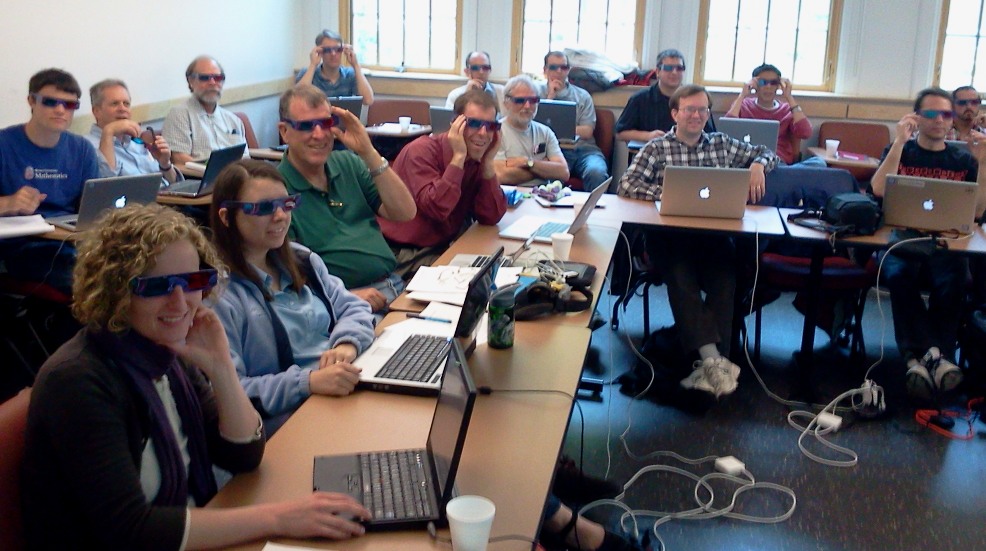
John Travis (Mississippi College) presented Sage in multivariate calculus. John is relatively new to Sage. He took the Sage PREP workshop last summer. John's presentation and worksheets are on the wiki. Much of the presentation was devoted to how one could use Sage in the classroom to help students with visualization. Cool 3-D graphics! This works extremely well with three-dimensional vector fields. you just need 3-D glasses.

It's harder to come up with worthwhile student projects. Here are some ideas for student projects that I have used in the past (Thanks to Wilfried Schmid at Harvard).

  • Give students the code to plot a cycloid and then ask them to write the code to plot an epicycloid.

  • Ask students to plot a monkey saddle and then a generalized monkey saddle.

What is needed is a place to collect problem and projects and a reviewing process to vet these?

Textbook Conversion

Rob Beezer (University of Puget Sound) presented Textbook conversions. The goal is to convert book length projects into Sage worksheets. The main tool for converting LaTeX to various forms is tex4ht. A bit of a technical talk, but nicely done and I learned some new things. Will these tools change the way that author textbooks or the way that students read their texts? Also needed is an author's guide.

General Comments and Ideas

  • Have a Sage worksheet for each class that you are teaching.

  • Project UTMOST needs a website.

  • Could we use what Rob has done to convert the SFA calculus labs?

The afternoons are devoted to working individually or in small groups on projects followed by status reports at the end of the day (a separate blog entry).